Commercial Roofing Built Around Occupied Buildings
Commercial Roofing in Daytona Beach for flat and low-slope commercial buildings with active tenants or rooftop equipment
Commercial flat roofs in Daytona Beach carry demands that residential pitched roofs do not: rooftop air conditioning equipment, wind exposure from hurricane-rated load zones, and membrane attachment details that have to be specified for those combined conditions. Wayne's Roofing and Sheet Metal works on occupied commercial buildings in Daytona Beach, coordinating directly with building owners and property managers so tenants and active businesses are not forced to suspend operations while the roof is replaced or repaired. The same crew handles both commercial and residential work, which means the scope of knowledge applied to each commercial project includes real experience with how roofs fail and how they hold.
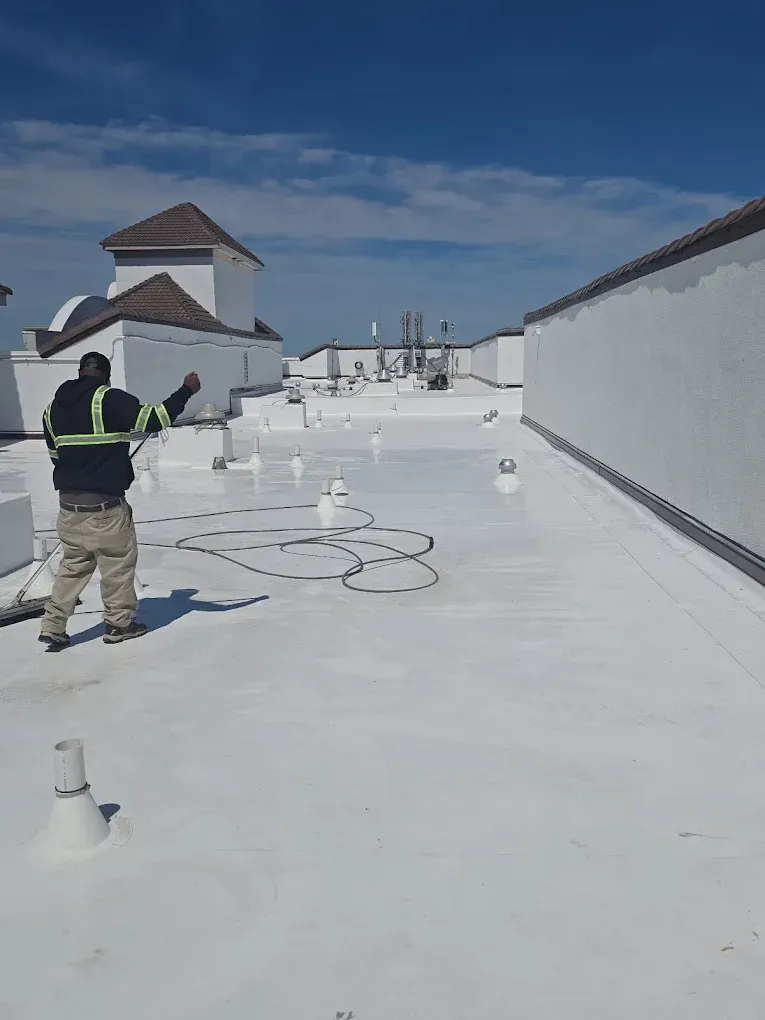
Every commercial roofing project begins with a condition inspection of the existing flat roof, assessing age, membrane integrity, substrate soundness, and the status of penetrations and flashing at rooftop equipment. The substrate is repaired before any new system or coating goes on, because placing a new membrane over a deteriorated or wet substrate produces a premature failure regardless of the quality of the material used. That inspection is where the recommendation—replacement, repair, or coating—gets made and where the work scope is documented before any material is ordered.
Request a building walkthrough and roof condition assessment to establish what your commercial roof requires and how the work can be sequenced around your tenants.
What Commercial Roofing Actually Accomplishes
Flat commercial roofs fail differently than pitched roofs. Membrane separation typically starts at penetrations, seams, and perimeter edges rather than across the field of the roof, and those failure points are often invisible from ground level until water has already reached the interior. Wayne's Roofing and Sheet Metal uses a crane that reaches eight stories for work involving rooftop equipment, which means heavy HVAC units, curbs, and equipment supports can be repositioned or replaced as part of a re-roofing project rather than worked around with compromises in the membrane layout.
Once the new roof system is in place, the building performs differently in ways the property manager will notice directly: interior ceiling stains stop developing, HVAC equipment operates on a stable, properly flashed curb, and the building owner has current documentation of what was installed and how the penetrations were detailed. That documentation matters for insurance purposes and for future roof management planning.
Holly Hill commercial properties and the older commercial stock along the Daytona Beach corridor often have roofs with a layered repair history—previous patch work, multiple coatings, or re-covered membranes—that requires the inspection to account for what is underneath the visible surface. Those conditions affect whether the existing substrate can be used as a base for a new membrane or whether a full tear-off is necessary before the replacement system goes on.
Answers About How the Work Is Done
These questions address the specifics of commercial roofing work on flat and low-slope buildings, including how occupied buildings are handled and what the inspection process involves.
How is work on an occupied commercial building sequenced to limit disruption?
The project schedule is developed with the building owner or property manager before work begins, identifying which areas of the roof are above active tenants and sequencing those sections to minimize noise and access interference during business hours.
What does a commercial flat roof inspection evaluate before a replacement recommendation is made?
The inspection assesses membrane condition, substrate moisture content, the integrity of penetrations and flashing at rooftop equipment, and the condition of perimeter edge metal—each of those components affects whether a repair, coating, or full replacement is the appropriate scope.
Why does rooftop HVAC equipment complicate a flat roof replacement?
Each equipment curb is a penetration in the membrane, and re-roofing requires either flashing the existing curbs into the new membrane correctly or replacing curbs that have rusted or shifted—skipping that step leaves the most common leak points unaddressed in the new system.
How does the attachment method for a flat roof membrane affect performance under high-wind conditions?
Membrane attachment on commercial flat roofs in wind-exposed markets like Daytona Beach has to meet specific pull-out resistance values at the perimeter and field of the roof—those values are determined by the building height, roof geometry, and local wind design requirements, not by a one-size specification.
What should a property manager look for in a finished commercial roof replacement to confirm the work was completed correctly?
Seams should be fully bonded with no lifting at edges, penetration flashing should wrap the curb and extend onto the field membrane, perimeter edge metal should be continuous and mechanically fastened, and drains should be recessed below the membrane surface so water moves toward them rather than pooling at the connection point.
Wayne's Roofing and Sheet Metal also performs commercial roofing in Ormond Beach, Holly Hill, Port Orange, DeLand, and Ponce Inlet. To begin a roof assessment for your commercial property, contact Wayne's Roofing and Sheet Metal at (386) 255-3633 and describe the building type and current roof condition so the inspection can be scoped appropriately.